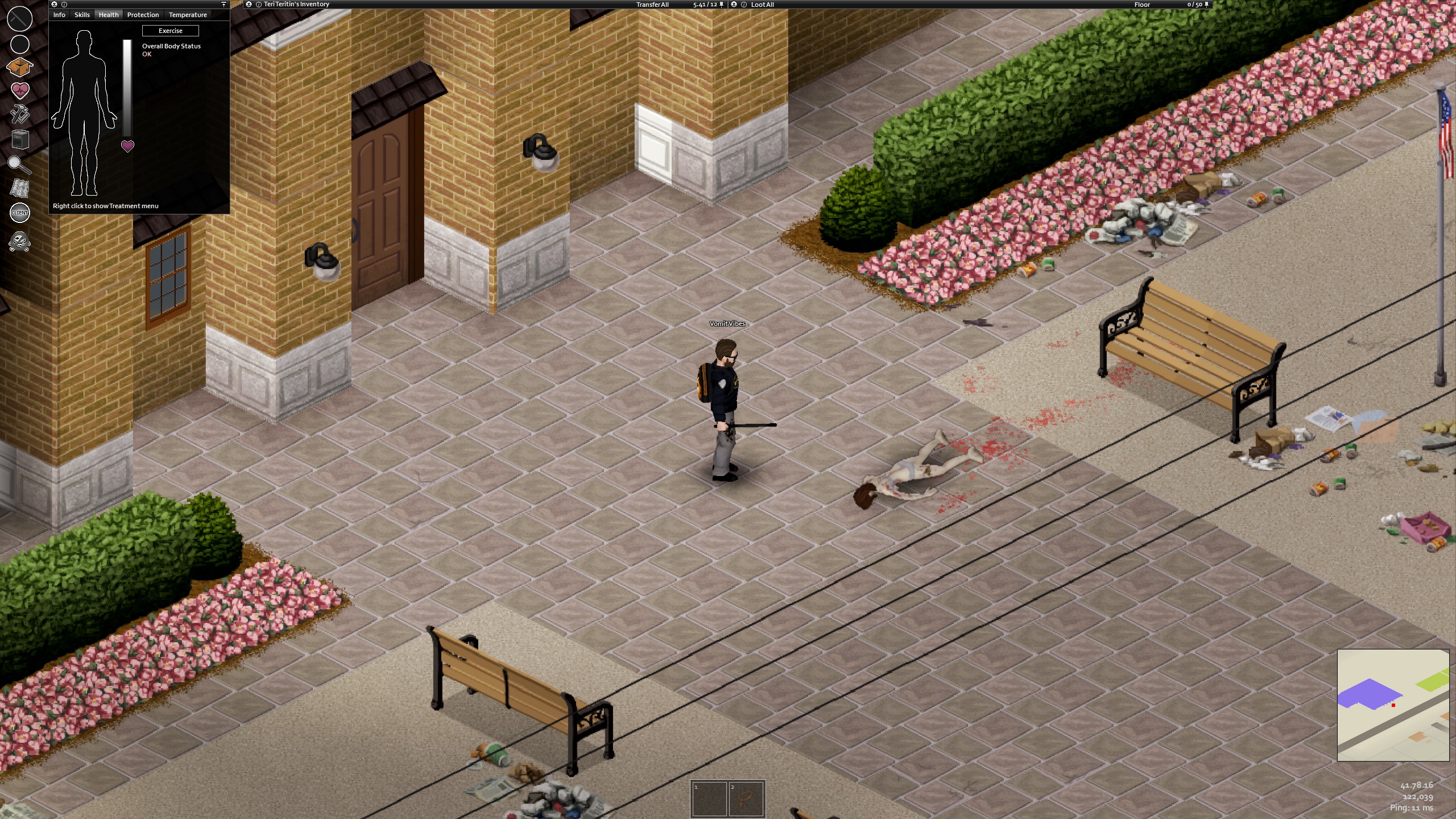
Project Zomboid Combat Guide: Melee, Firearms, and Zombie Horde Tactics
How melee damage and durability actually work, plus stealth kills, firearm noise costs, and horde control tactics that keep you unbitten.
Project Zomboid combat feels unfair until it clicks, and then it feels like a rhythm game where one wrong note ends a 40 day run. Zombies are slow, weak on their own, and dumb. What kills you is almost never a fair fight. It's getting tired mid swing, turning your back on one walker you forgot about, or firing a pistol in a quiet suburb and pulling forty new friends into the street.
The good news is that combat runs on rules you can learn. Damage, durability, noise, and detection are all numbers in the game files, and once you know them, most fights become choices instead of coin flips. Here's how the pieces fit together, from picking a weapon to walking away from a horde that would've eaten you last week.
Melee Weapon Damage and Durability Basics
What the damage numbers mean
Every melee weapon has a min and max damage per swing, a crit chance, and a crit multiplier. A baseball bat swings for 0.8 to 1.1 damage. When a crit lands it multiplies that, and crits are what actually kill zombies, since body shots alone take all day. Zombies carry health in the same rough range you do, so a plain bat swing chips away slowly while a crit can nearly drop a walker in a couple hits.
Weapon skill moves all of it. Higher Long Blunt means harder swings, more crits, and faster attacks with the same bat. A level 0 character and a level 7 character holding an identical crowbar are not playing the same game.
The stat people ignore is range. A spear reaches out to about 1.45 tiles, a hunting knife to 0.9. That gap is the difference between hitting a zombie and getting hit by it, and it's the whole reason long weapons feel safe and kitchen knives feel like a dare.
Weapons worth the inventory space
Numbers below are current vanilla values for build 42, pulled from fan wiki weapon data. Condition is max durability, and "loss" means roughly one point of wear per that many swings before skill.
| Weapon | Skill | Damage | Crit | Condition | Loss | Range | |---|---|---|---|---|---|---| | Crowbar | Long Blunt | 0.6-1.15 | 20% | 15 | 1/70 | 1.25 | | Baseball Bat | Long Blunt | 0.8-1.1 | 40% | 15 | 1/20 | 1.25 | | Metal Bat, Bolts | Long Blunt | 1.1-1.5 | 50% | 20 | 1/15 | 1.25 | | Hunting Knife | Short Blade | 0.6-1.2 | 50% | 10 | 1/15 | 0.9 | | Hatchet | Axe | 0.7-1.5 | 15% | 10 | 1/15 | 1.1 | | Firefighter Axe | Axe | 0.8-2.0 | 20% | 13 | 1/35 | 1.2 | | Wood Axe | Axe | 1.3-3.0 | 50% | 15 | 1/40 | 1.35 | | Machete | Long Blade | 2.0-3.0 | 20% | 13 | 1/25 | 1.23 | | Katana | Long Blade | 8.0 | 35% | 10 | 1/15 | 1.4 | | Spear, Kitchen Knife | Spear | 1.0-1.6 | 20% | 7 | 1/4 | 1.45 |
Read the loss column before the damage column. A kitchen knife spear hits fine and dies in a handful of swings, since plain wooden spears lose condition about every second hit. The crowbar is the opposite trade: modest damage, but one point of wear per 70 swings, plus it pries barricades. That's why half the community treats it as a permanent fixture rather than a weapon.
The katana is the damage king at a flat 8.0 per swing and nothing else is close. It's also rare, capped at 10 condition, and can't be sharpened in build 42, so enjoy it like a borrowed thing rather than a plan.
One setting matters more than any row above: Weapon Multi Hit. On the default Apocalypse preset it's off, so one swing hits one zombie. Some other presets and most servers turn it on, and then wide blunt weapons and axes jump in value because their multi hit counts finally apply. Half the "best weapon" arguments online are two people on different settings talking past each other.
Durability and the Maintenance skill
Condition drops are a dice roll per swing, and the Maintenance skill weights the dice. Every Maintenance level, plus every level in the weapon's own skill, improves your odds of a swing costing nothing at all. A crowbar in the hands of someone with high Long Blunt and decent Maintenance can last thousands of kills.
You can also cheat wear by not swinging. Stomping a downed zombie with your boot costs zero durability and kills reliably. Shove a zombie over, stand near its head, stomp. For one or two walkers this is just better than swinging, and it saves your good weapon for the day you actually need it.
Build 42 stacked muscle strain on top of endurance, and heavy tools like the wood axe or sledgehammer build it fast when you spam attacks. Tired arms swing worse. Mix in shoves and stomps, or simply stop swinging for a bit.
Managing Sneak Attacks and Stealth Kills
How zombies notice you
Detection is sight plus sound, handled separately. Zombies have a facing and a vision cone, so a walker staring down the street will spot you at range while the same walker facing away won't see you until you're close enough to touch. Rain and darkness shrink that vision. Sound is footstep based and rolls per step: at Lightfooted 0 you've got roughly a 1 in 2 chance of making noise each step while walking, and about 1 in 4 while crouched.
The skills that matter are Sneaking, which only applies while crouched and shrinks how visible you are, and Lightfooted, which cuts footstep noise whether you're sneaking or not. Nimble speeds up your crouch walk. On traits, Graceful cuts movement noise by about 60% and Inconspicuous roughly halves the chance to be spotted. Both are cheap for what they do if you're building a quiet character.
Line of sight beats all of it. Crouching in the open does very little. Crouching behind a fence, a hedge, or a parked car breaks the sightline completely, and that's the actual technique. Pick your route around cover instead of tiptoeing across open asphalt.
The jaw stab
This is the one true stealth kill in the game. With a knife equipped and exactly one zombie aggroed, walk into range and your character raises their off hand. That's the tell. Swing and you get the jaw stab animation, a blade driven up under the chin that kills a full health zombie instantly and silently.
Three rules govern it:
- The animation only offers itself when one zombie is targeting you. Get two or more aggroed and the game disables it entirely, distance irrelevant.
- The chance to land it scales with Short Blade skill and with the knife. A hunting knife or combat knife does far better than a butter knife or a pen.
- You don't strictly need to be behind the target. Sneaking up works, but so does jaw stabbing a walker that's still turning toward you, if you close the gap fast and time the swing.
In practice the flow is crouch, approach from behind at an angle, wait for the raised hand, swing. If the hand isn't up you're not getting the kill, so back off and reset instead of mashing the attack button.
The payoff is a free kill with zero noise and zero durability. Chain it down a street of scattered walkers and you can clear a block without any of them knowing you were there. It falls apart the second a second one notices you, which is why dense areas get cleared some other way.
Building for quiet
If you want stealth as your main tool rather than a party trick, invest in it. Sneaking and Lightfooted level fastest by crouch walking everywhere near zombies, since XP trickles in whenever one is close enough to potentially spot you. A quiet looting loop through a suburb is also training, which is a nice deal.
Take your boots off for genuinely delicate approaches. Barefoot or socked steps are quieter, with the obvious catch that you can cut your feet on broken glass, so treat it as a situational tool. It pairs fine with the jaw stab, since you're moving slow anyway.
When to Use Firearms Versus Melee
Noise is the real cost
A gun in Project Zomboid isn't a weapon, it's an invitation. Noise radius is measured in tiles and the numbers are brutal on build 42 data: every 12g shotgun sits at a 200 tile radius, the .308 rifles around 170, an M9 pistol 100, an M1911 70, and the little SN38 revolver 60. Fire a shotgun in West Point and you've mailed a flyer to everything within a third of the town.
So the melee versus guns question is really a noise question. Melee is quiet, free to feed, and infinite. Guns solve problems melee can't touch, but every shot creates two more.
| Gun | Ammo | Damage | Range | Noise | Notes | |---|---|---|---|---|---| | JS-2000 Shotgun | 12g | 1.5-2.2 | 12 | 200 | Hits up to 9, huge knockdown | | M1911 Pistol | .45 ACP | 0.9-1.2 | 12 | 70 | Quieter sidearm | | M9 Pistol | 9x19mm | 0.6-1.0 | 15 | 100 | 15 round magazine | | M1A Rifle | 7.62x51mm | 1.2-2.0 | 40 | 170 | 20 rounds, pierces | | Trapper Carbine | .45 ACP | 1.0-1.4 | 20 | 70 | Quietest long gun |
Skill gates hit harder than stats
The Aiming skill decides whether a gun is useful, and low Aiming is genuinely awful. A level 0 character with a pistol misses constantly at anything past arm's length, and the fix isn't better trigger discipline, it's levels. Shotguns are the exception. Their high base hit chance and pellet spread forgive sloppy aim, which is why everyone's first firearm is a JS-2000.
Turn the aim outline on in the options. It marks which zombie your character is actually pointing at, and the marker reflects your current hit chance. Without it you're guessing, and the answer is often not the walker you wanted.
Panic stacks on top. A character without Brave or the Veteran trait shakes and loses accuracy as zombies close in. Veterans get the Desensitized trait, which makes them far less prone to panic, and beta blockers help everyone else. Pop one before a planned gunfight, not during.
When a gun is the right call
Guns earn their noise in a few specific spots. Shotguns when you're already cornered and a cluster is closing, since the knockdown and pellet spread delete a group that melee can't. Rifles for clearing a stretch of road from a rooftop or window, where responders walk toward you in a line you can keep shooting. And any firearm when you're hurt, exhausted, or outnumbered and just need room to run.
What doesn't work is casual popping. Firing near your base, firing indoors with no exit, or firing with six rounds and no reload plan are all run-enders. The pattern that works is pick the spot, clear it loud, kill whatever the noise pulled in, then leave the area for a while before coming back to loot.
Ammo isn't renewable in vanilla either. There's no crafting live cartridges, so every round you fire is a round leaving the world for good. Treat them like a savings account you only break into for emergencies, and let melee stay your daily driver.
Fighting Hordes Without Getting Surrounded
Pull from the edge
Never walk into a group. Crouch, edge forward until one or two zombies at the fringe notice you, then back off and let them separate. Their speeds differ slightly, so a blob pulled a few tiles turns into a loose line within seconds. Kill the line, repeat. A horde of thirty handled two at a time is thirty easy fights. Handled as a blob, it's a death.
Set a disengage number before you start. If five feels like your limit today, leave at five, not at seven when you're already winded. The players who die to hordes are usually the ones who kept going one more zombie past their comfortable number.
Space control is the whole fight
Backpedal while you swing. Standing still while aiming is how you get flanked, because zombies path around you the instant there's room to. Walking backward in combat stance keeps every target in front of you, and the Nimble skill raises your combat stance speed so you can do it faster than they walk.
Use the shove constantly. Spacebar while aiming shoves instead of swinging, and a shoved zombie staggers back and often falls. It costs no durability, interrupts a grab, and sets up a stomp. When one goes down, stand near its head and stomp it, or literally stand on top of the body to pin it while you handle its friend.
There's a hidden bonus worth knowing here too: consecutive hits on the same target stack a damage multiplier, so the fourth straight hit lands noticeably harder than the first. Focusing one zombie down beats spreading swings across three of them.
Use terrain like a weapon
Short fences are the classic. Zombies that climb one lunge over and land prone, and a prone zombie is a free stomp. The risk is timing, since one climbing mid swing can knock you down instead, so step back from the fence line and let them come to you. Fighting along a fence turns a horde into a queue of staggered, falling walkers you handle one at a time.
Windows do the same job indoors. Zombies climb through slowly and one at a time, so a window you can stand beside is a funnel. Cars work too. Stand on the far side of a sedan and the pathing bunches up against the body.
Tall fences are your escape hatch rather than a fighting tool, since zombies can't climb them at all. Vault one and the horde has to walk around, which buys a clean ten to twenty seconds. Check what's on the other side before jumping, though, because landing next to a fresh walker with your back to the horde is a bad trade.
Trees and building corners break line of sight. Zombies walk toward where they last saw you, not where you actually are, so a sharp turn around a building pulls them onto a predictable path. That single move can shed half a horde before they reacquire you.
Common Combat Mistakes That Get You Bitten
Know the stakes first. On default settings a bite is a guaranteed Knox infection and a dead character within two or three days. Lacerations run about a 25% infection chance, scratches about 7%. The attack roll itself, before any of that, is roughly a coin flip between a scratch, a laceration, a bite, or nothing. Every hit you take is a lottery ticket you didn't want.
Fighting tired
Drowsy characters swing slower, hit weaker, and get grabbed more. The tiredness moodle is all over death screens, because players push one more building before sleeping. If it shows up mid fight, that fight is over. Leave.
Same deal with exertion. Once endurance drops, your attacks slow way down and you stop knocking zombies over. Endurance comes back fast if you walk instead of sprint, so the fix is usually ten seconds of walking away. Most players refuse to do it.
Ignoring what's behind you
Zombies path around. Two walk past you to get behind you, and suddenly your exit is gone. Check your flanks between swings, and fight with your back to something solid like a wall, a fence line, or a car so there's less behind you to watch. Getting hit from behind is worse than a front hit, since you never see it coming to shove it off.
Panic swinging
Mashing attack while surrounded burns condition fast and hits almost nothing. Wild swings at multiple zombies connect less, wear the weapon quicker, and create no space. When things get tight, the right button is usually the shove, or the walk backward key. The stomp is the other one people forget exists. A downed zombie at your feet is a free kill, and most players swing at the standing ones instead.
Turning to run at the wrong moment
There's a delay on the 180 turn, and getting grabbed mid turn is a classic death. If you need out, stop swinging first, take a couple backpedal steps, then turn. Charging the sprint button while your character is mid swing animation produces the stumbling half rotation that gets people bitten.
Using the wrong tool for the job
Kitchen knives against three zombies. A sledgehammer on low endurance. A shotgun next to your base. All three are the same mistake, picking a tool for its damage number while ignoring everything around it. Fragile weapons belong in one on one situations, heavy ones where you have stamina to spare, and guns far from anywhere you care about.
Not carrying a backup
Weapons break at the worst moment, and a character with one weapon is a character who will eventually be unarmed. A crowbar plus a hunting knife weighs almost nothing and covers both the horde case and the stealth case. Even a spare plank beats fists.
The pattern under almost all of these is the same. Bites don't come from hard fights, they come from the moment you stopped paying attention. The tired swing, the unchecked corner, the one walker you walked past. Fight fresh, fight facing one direction, and leave early, and you'll die of old age in Knox County instead.