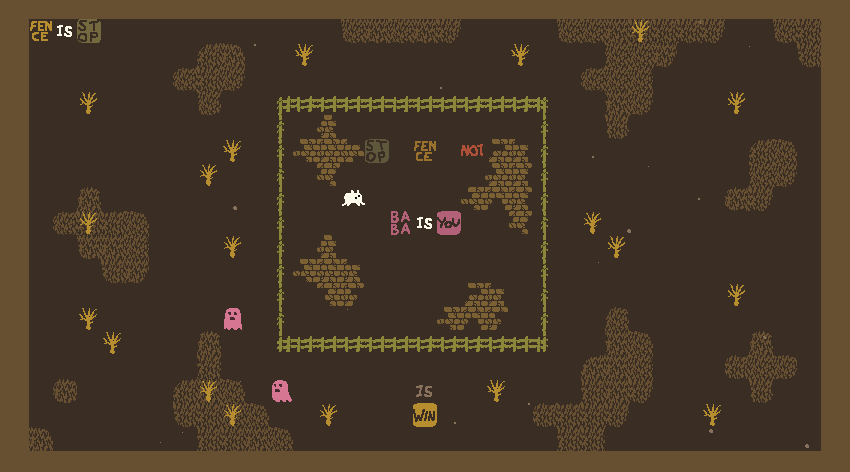
Baba Is You: Rule Manipulation and Puzzle Solving Guide
Master rule manipulation, object interactions, and lateral thinking to solve puzzles and conquer challenges in Baba Is You with our expert guide.
Few puzzle games shake up your expectations quite like Baba Is You. It’s not just about figuring out a solution within the rules — it’s about rewriting those rules entirely. At first glance, you’re nudging little characters around to reach a goal, but before long, you’re realizing just how flexible the world can be when words themselves become your tools. With each level, things get a little trickier, and the way you interact with the game world keeps evolving. Whether you’re swapping roles between objects or bending the definitions of victory, there’s always a new trick to learn and plenty of surprising logic to untangle.
What Does "Rule Manipulation" Mean?
In Baba Is You, every puzzle centers on moving words around to change what is even possible within the level. The core idea: rules are written with word blocks — things like “BABA IS YOU,” “FLAG IS WIN,” or “WALL IS STOP.” Push a word out of the line or rearrange it, and you don’t just break the rule... you rewrite how the game reacts to everything.
Rule manipulation means more than switching a single block here or there. You’re free to reshape the level’s physics and logic by adjusting these phrases. Sometimes, making a rock behave like a key is the only way out. Other times, you’ll need to strip away the powers of a wall or even remove your own control from Baba (careful with that one). Mastering this mechanic is the key to solving even the wildest puzzles.
Reading and Understanding Rules
The basis for any solution is figuring out the rules on the board. Sentences follow a simple formula: [Object] IS [Property/Object]. Here’s what each word does:
- Object: Anything that appears on the map (BABA, ROCK, WALL, FLAG, etc.)
- Is: Connects the object with a property or another object.
- Property/Object: Properties describe behavior (YOU, WIN, STOP, PUSH). Sometimes, the sentence turns one thing into another (e.g., “ROCK IS WALL” changes all rocks into walls).
If the words are lined up horizontally or vertically in a straight, uninterrupted line, the rule is active. Interrupt the line (move a block out), and the rule disappears. Level layouts often mix several rule possibilities, so double-check all active rules before making moves.
Changing Active Rules
Manipulating the board means you can:
- Push an entire rule aside to deactivate it.
- Swap words to make new rules (turn BABA into ROCK).
- Stack multiple rules for combo effects (FLAG IS WIN, FLAG IS PUSH).
Just remember that if a rule isn’t actively formed, it doesn’t apply anymore.
Deactivating Rules
Let’s say “WALL IS STOP” prevents you from moving through walls. If you break up the sentence (move “STOP” away from the others), suddenly every wall can be walked through. This trick removes barriers and sometimes triggers solutions hiding behind solid blocks.
Creating New Rules
Combine words to help you win. If “BABA IS YOU” and “FLAG IS WIN” are on the board, but you’re blocked off from the flag, try making “BABA IS WIN.” Now, if you control Baba, you instantly win — no flag needed. The combinations can get wild.
Transforms and Metamorphosis Rules
The game lets you mess with identity. For example, “ROCK IS BABA” turns all rocks into controllable Babas. Sometimes, puzzles include several transform possibilities, making you control new characters or change an item’s use to solve a problem.
Be careful: if “BABA IS YOU” is broken with no replacement, you lose all control, and the puzzle resets or becomes unsolvable.
Managing Multiple Rules
More complex puzzles throw several sentence blocks at you at once. Some rules overlap or interact:
- Multiple YOUs: If both “BABA IS YOU” and “ROCK IS YOU” are active, you control both at once.
- Property Stacking: An object can be multiple things at the same time (e.g., “FLAG IS WIN,” “FLAG IS PUSH” lets you push the flag and win by touching it).
It’s all about keeping track of what’s currently possible and not losing sight of how rules layer together. Sometimes deleting a rule is just as important as adding one.
Edge Cases and Gotchas
Not every change works the way you expect. Here are some heads-up tips:
- If you move the last “YOU,” you won’t be able to control anything. Always keep a way out.
- Some objects let you create loops (“BABA IS ROCK, ROCK IS BABA”), which can make things swap back and forth — handy for advanced levels or getting through blocked spaces.
- Rules can get overwritten if the same object is the subject in more than one sentence. “BABA IS YOU” and “BABA IS ROCK” at once makes every Baba a rock, removing your control.
Practice & Experiment
No two puzzles are solved in the same way. Experiment. Get things “wrong.” Sometimes the weirdest rule combo ends up being the answer. Keep an eye on how messing with even a single word can flip the entire logic of a level.
Baba Is You puts the power of the entire world in your hands, with just a push of a word. Try out combinations, break and make rules, and watch as levels completely change shape. The more you play with these sentence blocks, the more possibilities open up. Happy puzzling!
Object Interactions
In Baba Is You, objects do way more than just sit around waiting for you to push them. Every item in the game—Baba, Wall, Rock, Lava, Key, Flag, and plenty more—takes on different roles depending on which rules are active. Understanding how objects interact with each other and with the rules is the backbone of solving tougher puzzles. Let’s break down how objects behave, collide, and swap properties, and some tips on thinking several steps ahead.
Basic Object Behavior
Most objects in the game have default properties assigned by the puzzle’s rules. Here are the key properties and what each means:
- PUSH: You can move this object around like a chess piece. Its path can be blocked by other “STOP” objects, the edge of the level, or even other “PUSH” items.
- STOP: This object blocks your movement; you can’t walk through or push past it.
- YOU: This is what you control. There can be more than one “YOU” object, and you control all at once.
- WIN: You finish the level by touching this object (as long as something you control hits it).
- DEFEAT: Touching this object deletes whatever controlled object walks into it.
- OPEN/CLOSE: Used together to allow some objects to interact. “KEY IS OPEN” and “DOOR IS CLOSE,” for instance, means pushing the key into the door removes both.
- HOT/MELT: “HOT” objects destroy “MELT” objects if they touch. For example, “LAVA IS HOT” and “BABA IS MELT”: if Baba steps into lava, poof!
- SINK: Any object (including you) falls into a “SINK” square, both disappear instantly.
These properties define most of the game’s mechanics. What makes things tricky is how these get even wilder once you start mixing properties or changing what counts as which object.
Combining Object Properties
Objects can hold more than one property at a time. For example, “ROCK IS PUSH AND HOT” makes every rock carry both attributes: it can be pushed, and it will burn up “MELT” objects. Mixed properties lead to wild interactions:
- PUSH + SINK: You can shove a sinking item into another and watch both vanish.
- YOU + MELT: Watch out—if you’re “MELT” and anything “HOT” crosses your path, you’re toast.
- OPEN + PUSH: Something can be carried around and used for unlocking later.
This is one of the most creative aspects of Baba Is You. Every property you attach or remove can totally alter a puzzle’s logic. Sometimes, stacking properties is the only way to make progress, especially in levels where you can’t reach an objective via a direct path.
Swapping Object Identities
Some puzzles center on transforming objects into each other, not just their properties. For example, “BABA IS ROCK” swaps all Babas for rocks. Oppositely, “ROCK IS BABA” flips all rocks into Babas. It gets especially interesting if both rules are active (e.g., “BABA IS ROCK” and “ROCK IS BABA” together) because every Baba becomes a rock and every rock becomes Baba—sometimes causing endless cycles.
- Two-way transformations: These can fill up or erase the board, introduce infinite loops, or let you sidestep obstacles entirely.
- Property inheritance: When something changes form, it usually keeps rule-based properties like “YOU” or “PUSH.” So if you turn all rocks into Babas while “ROCK IS YOU” is up, suddenly you might have half a dozen Babas under your control.
Always be on the lookout for opportunities to shift identities and spread properties. This is how some puzzles strain your brain the most: you’ll need to make sure properties transfer correctly in order to set up winning conditions.
Object Collisions
How objects react to bumping into one another depends entirely on which properties are currently assigned. Here’s how some typical scenarios play out:
- STOP vs. PUSH: If an object is both, you can still move it—unless something “STOP” blocks it.
- PUSH vs. PUSH: Two “PUSH” objects next to each other will move together if pushed.
- YOU vs. DEFEAT: Controlled objects are instantly eliminated on contact. If all “YOU”s are defeated, it’s game over.
- OPEN vs. CLOSE: Colliding these results in both disappearing—useful to clear a pathway.
Sometimes, a combination of properties yields unique reactions. For example, a “HOT” and “SINK” object will destroy both a melting object and itself when the right collision occurs. Getting familiar with how combinations play out will save time tinkering with trial and error.
Special Interactions & Edge Cases
Baba Is You encourages experimentation, so there are plenty of quirky results from certain setups:
- Stacked objects: Two or more items can share a tile—rules like “BABA IS YOU” and “ROCK IS YOU” could place both Baba and Rock at the same spot, moving as one.
- Property loss/gain: If you overwrite a property (“BABA IS PUSH,” then remove the rule), Baba is no longer pushable. Watch for accidental changes that can trap you or make puzzles unsolvable.
- Chain reactions: If “WALL IS SINK” and something gets pushed into the wall, both vanish, possibly revealing hidden paths or exposing word blocks.
Planning Ahead and Using Interactions
Success in harder levels means thinking a few steps forward. Here’s some advice for using object interactions:
- Scan current rules: Always look over which properties belong to which objects before making moves.
- Predict chain reactions: Ask, “If I push this here, what will fall away? What’s left behind?”
- Prepare backups: Don’t lock yourself out by removing your access to an object or key rule block.
- Test combos: Try combining different objects and properties—you’ll be surprised at what’s legal, and what solutions it unlocks.
Common Pitfalls to Watch Out For
- Losing yourself: If your only “YOU” object is destroyed or transformed, you lose the level.
- Infinite loops: Too many identity swaps can sometimes lead to unintended repeating states. Keep a close eye on how forms cycle.
- Irreversible moves: Using “SINK,” “OPEN,” or “DEFEAT” removes objects for good. Don’t delete the piece needed for a key rule.
Wrapping Up Object Interactions
Working out how objects behave, combine, or shift forms sits at the heart of Baba Is You’s puzzles. Most tough challenges play with interactions you might not spot at first glance—so stay curious and don’t be afraid to mess up. Each move is a chance to notice a new trick. When you get stuck, backtrack and consider how tweaking even one property or identity could turn the level upside down. The game rewards this kind of creative problem-solving more than anything else.
Lateral Thinking
Baba Is You doesn’t just reward following obvious logic—it encourages you to break your own mental habits. Lateral thinking, or finding unexpected solutions by reframing the problem, is at the heart of this game’s trickiest moments.
Breaking Out of Linear Logic
It’s easy to focus on “step A leads to step B leads to win.” But in Baba Is You, that kind of straight-line process often falls apart. The best solutions usually come from looking at a puzzle sideways and asking, “What if I do something weird here? What if I don’t care about the flag?”
For example: running into a dead end because you can’t reach “FLAG IS WIN”? Well, maybe you can turn something else into the win condition, or even make “BABA IS WIN.” The game almost begs you not to get stuck thinking there’s only one route to success.
Rethinking What’s Possible
A lot of puzzles look impossible until you challenge the game’s basic rules. Here are some common mind-benders:
- Turning goals on their head: You may need to ignore the obvious win object and use an alternative method.
- Treating rules as objects: Ruleblocks themselves can be manipulated. If you can’t reach a word, maybe you can bring the word to you.
- Questioning assumptions: Just because “WALL IS STOP” at the start doesn’t mean it needs to stay that way. If you dismantle or redirect how walls work, new paths open up.
Spotting the Unconventional
The farther you go in Baba Is You, the more puzzles ask you to spot solutions hiding in plain sight. Here are some signs a puzzle wants you to rethink your approach:
- Too simple or too isolated: If an object or word isn’t part of the direct solution, ask if that’s a misdirection or a hidden key.
- Dead-end routes: If following the “logical” steps leads nowhere, try flipping the map in your head.
- Unused ruleblocks: Sometimes, words tucked off to the side (like “HAS,” “SHIFT,” or “TEXT”) are there for a reason—even if it’s not obvious at first.
Lateral Thinking Tactics
Here are a few strategies to help get your thinking out of a rut:
1. Misuse the Obvious
Try applying a property or identity in a way it was “never meant” to be used. For instance, making a rule like “WALL IS YOU” to take over all walls at once, or “EMPTY IS WIN” so victory is everywhere.
2. Use Temporary Rules
Sometimes you only need a rule active for a split second. Make something “PUSH” just long enough to move it, then switch it back to “SINK” before it gets in the way.
3. Win Without Moving
Who says you need to reach the win object? If you can make “BABA IS WIN” or “ROCK IS WIN,” you win instantly—no movement needed.
4. Cross Properties Creatively
Play around with chains like “BABA IS YOU,” “YOU IS WIN,” or even “ROCK IS FLAG.” Maybe you only need to be the right object at the right moment, not the whole time.
5. Trick Your Own Mind
Force yourself to look at the rules and pieces as totally separate from their usual functions. Sometimes it helps to close your eyes and say out loud: “What if ‘TEXT IS YOU’ and I walk my ruleblocks to the flag?”
Recognizing a Lateral Puzzle
Not sure when to abandon direct logic? Here’s a quick checklist:
- Are you stuck with no obvious moves?
- Are there ruleblocks or objects that seem useless?
- Have you tried flipping, swapping, or transforming identities and properties in unexpected orders?
If the answer is yes to any of these, it’s time to experiment. The solution may be wild, but once you see it, it’ll feel obvious.
Accepting Failure and Experimentation
Getting things “wrong” is a key part of how Baba Is You teaches you to think laterally. Try a solution you know won’t work just to see the results. Sometimes, a failed experiment sparks the actual answer.
- Use undo: The game encourages trial and error with its generous rewind feature. Don’t hesitate to backtrack and try a new tack.
- Ask “what if?” often: If you ever find yourself thinking, “But obviously, I can’t do that”—try it anyway.
Famous Lateral Thinking Moments
To wrap up, here are some real examples from the game that use this kind of thinking:
- “EMPTY IS YOU”: Suddenly, you control all the empty spaces on the map instead of any object.
- Winning by elimination: Make every object disappear with “SINK” or “DEFEAT,” then trigger “BABA IS WIN” at the last second.
- Double identities: Set up a situation where “FLAG IS ROCK” and “ROCK IS WIN” overlap so your target turns into your victory condition.
Conclusion
Lateral thinking can feel awkward at first if you like rules and clean logic. But it’s Baba Is You’s main twist—puzzles are often upside down, inside out, or solved by breaking what seem like “unbreakable” conventions. Next time you’re stuck, don’t just look for clever mechanics. Rethink everything. The solution might just be one bizarre rule away.
Understanding Level Objectives
Every level in Baba Is You starts with a simple, silent prompt: What counts as “winning” here? The twist is, that question shifts from stage to stage. Sometimes, just touching a flag is enough. Sometimes, the entire challenge is about creating a win condition from scratch. Here’s what you need to know when sizing up any stage.
The Basics: “___ IS WIN”
Nearly every puzzle revolves around at least one word sequence that sets the victory condition—usually “FLAG IS WIN.” This means touching a flag wins the level. But Baba Is You is all about shifting definitions. That phrase can be swapped, tweaked, or outright invented.
What to Look For At The Start
- Objects and Text: Check what words and items you can interact with—not just Baba and the flag, but every visible word block.
- Active Rules: Identify which rules are currently formed by the arrangement of word blocks. These dictate what can move, what you control, and what counts as an obstacle or a goal.
- Obvious Pathways: Notice if there’s a direct way to reach the win object, or if something (like walls or water) stops you.
Here’s an example:
- You see “BABA IS YOU,” “FLAG IS WIN,” and a few walls with “WALL IS STOP.”
- The flag is stuck behind a wall.
- You immediately know: Going for the flag won’t help until you “rewrite” the rules.
Winning Isn’t (Always) The Goal You Expect
Sometimes the object that “is win” isn’t reachable. Sometimes the words are there to let you make something else the win condition. The stage might let you:
- Change “WIN” to a different object: If “BABA IS WIN,” you win instantly since you’re already controlling Baba.
- Switch identities: “ROCK IS WIN” now means touching a rock ends the level.
- Chain rules: “FLAG IS ROCK” and “ROCK IS WIN” makes the flag turn into your new victory target.
Before you move a single tile, ask yourself: Can the victory condition change? Are my starting rules the only option, or can I flip things around?
Rule-Blocking and “NO WIN” Traps
It’s common to find stages where the “WIN” rule is partially or completely blocked:
- Words might be separated by obstacles.
- Only one or two word blocks are actually movable.
This means your objective is layered:
- Find out if you can make a rule with “___ IS WIN.”
- If not, look at the available words—is there a workaround, like “BABA IS WIN” or “TEXT IS WIN”?
- If nothing says “WIN,” your job is to create that rule first, sometimes by clearing paths, pushing words, or transforming other words into “WIN.”
When There’s No “WIN” …
Some puzzles leave out the “WIN” block entirely—early in the campaign, that seems impossible, but the solution is usually about creating or revealing it:
- Maybe “TEXT” can become win, so you make “TEXT IS WIN.”
- Maybe you push items to create “BABA IS WIN” or another surprise rule using the blocks you have.
Take a close look at stray or seemingly “useless” word blocks. Sometimes, the answer to the level objective is hidden out in the open.
Secondary Objectives: Gimmicks, Gags, and Hidden Goals
Not every stage follows the “reach the flag” mold. The game throws curveballs where:
- You control something besides Baba (like “ROCK IS YOU”).
- You win by transforming objects (such as “WALL IS FLAG”).
- Victory is possible only by activating a chain of events (“CRAB IS BABA,” then “BABA IS WIN”).
Other times, stages require you to:
- Clear the screen: “BABA IS DEFEAT,” “FLAG IS DEFEAT,” and “EMPTY IS WIN” means you win when everything else is wiped out.
- Occupy a specific position: Win only occurs if an object is moved onto a certain space (sometimes achieved with “COVERED IS WIN” or similar tricks).
Mastering Level Objectives: Some Practical Steps
1. Scan All Rules and Objects
Start every level by quickly reading all visible word blocks and scanning for possible new rule combinations, even if they seem strange.
2. Mentally Rewire the Objective
If “FLAG IS WIN” is unreachable, think “What else could be win?” Having “WIN” accessible as a block is a massive hint that you should shake things up.
3. Experiment With Rule Sequences
Often, a level involves using temporary rules:
- Make “ROCK IS YOU” just long enough to move a rock into a helpful position, then turn “ROCK IS WIN” for the finish.
- Set up combos like “BABA IS FLAG,” then “FLAG IS WIN,” swapping your identity and victory target in the same move.
4. Don’t Ignore Text Blocks As Objects
Sometimes “TEXT IS WIN” really is the answer! If something odd and seemingly useless sits in the corner, ask yourself, “Can I make that the win?”
5. Remember the Undo and Restart
You’re not penalized for trying wacky combos. If your new win condition strands you, just tap undo or restart. Experimenting leads to those “aha!” moments the game is known for.
Level Objective Checklist
Before making a move, ask:
- What’s the current win condition?
- Can I reach the win object or change what “WIN” refers to?
- Are there unused or extra text blocks that let me rewrite the rules?
- Did I try switching identities–maybe “BABA IS FLAG” or “ROCK IS YOU” can turn the level upside down?
- Is there a way to set up a chain of rule swaps for a roundabout victory?
Conclusion
In Baba Is You, figuring out the real goal of each stage is half the puzzle. Don’t lock yourself into the first win condition you see—sometimes, the whole lesson is that the win itself can (and should) change. Stay curious, experiment with what “winning” means, and enjoy every twist in how objectives get redefined. Each stage is a new chance to surprise yourself.
Advanced Techniques
Baba Is You tosses the usual puzzle game expectations out the window—sometimes literally, with rules like "TEXT IS FLOAT." Once you’re comfortable rewriting basic goals, it’s time to tackle more complex maneuvers. Here, nuanced strategies and clever word manipulation take center stage. Let’s break down some core advanced techniques that separate casual players from the true brain-benders.
Rule Layering
Rules in Baba Is You aren't limited to what you can see on the screen at first glance. Layering involves making two or more rules apply at the same time—sometimes even to the same objects.
- Double Identity: If you create rules like “BABA IS YOU” and “ROCK IS YOU,” you’ll move both Baba and every rock with the same input. This can let you move multiple objects in sync, unlock otherwise unreachable blocks, or chain a solution that needs more than one object cooperating.
- Stacked Properties: An object can have more than one rule. For instance, “FLAG IS WIN AND PUSH” makes a flag both your victory condition and a pushable object. You might need to shift the flag while also making it the goal, which gives you more flexibility—but watch out for pitfalls if you push it out of reach!
Always consider whether two rules can work together, instead of just swapping one for another.
Using Text Blocks as Tools
Text blocks do more than form new rules. They have physical presence in the world, and that can open up advanced tactics:
- Blocking Hazards: Need to cross water, but only have word blocks nearby? Try pushing “BABA” or “IS” onto the water to fill it. Some stages let you use text as stepping stones, as long as "TEXT IS PUSH" stays active.
- Creating Bridges: Sometimes, arranging text blocks forms crucial bridges or barriers. Use text’s physicality as part of your plan, not just as a way to write sentences.
Don't forget: "TEXT IS PUSH" can make or break an entire stage. Without it, word blocks can’t be moved—unless you cleverly rewrite that rule, too!
Meta Rules and Self-Reference
Occasionally, levels give access to quirky self-reference, introducing rules that affect rules:
- “TEXT IS TEXT” and Self-Locking: If you set “TEXT IS TEXT,” the game prevents word blocks from transforming into other things (e.g., "BABA IS TEXT" won't create replicas). This can stabilize a level by preventing unwanted changes—or foil a shortcut you were relying on.
- Rule Cascading: Activate one rule temporarily, then switch to another by pushing word blocks in sequence. Sometimes, you need to set things up so that walking onto a word block automatically rewrites the rules for you.
These meta-puzzles are among the toughest—every step changes what’s possible in the next moment.
Remote Rule Changes (“IS” as a Connector)
You’re not always limited by proximity. Pushing a single “IS” block can sometimes create long-distance connections, letting you make rules across the map:
- Pivot Points: Position “IS” so it sits between two different objects and push words around to swap rules rapidly (“BABA IS YOU” becomes “BABA IS WIN” with one block move).
- Rule Chains: Sometimes the board’s layout lets “IS” connect to several words at once. Experiment with pushing from both sides or making horizontal and vertical combos simultaneously. For instance, “BABA IS ROCK IS YOU” would turn Baba into a rock and let you control it right away.
Keep in mind: there are rare cases where activating multiple "IS" connectors in the right order solves what looks like an impossible puzzle.
Using Undo for Advanced Planning
The undo button isn’t just a way to fix mistakes. It’s a powerful tool for experimenting with branching solutions:
- Step-by-Step Testing: Nudge blocks forward, then undo several steps to try a different rule order. This lets you test several possible outcomes before committing.
- Timeline Branching: Create a temporary rule, reach a certain point, then undo and use your knowledge of what works to find a quicker or safer route.
Don’t be shy about rewinding. Many expert players rely on carefully stepping through possible moves, using memory and trial-and-error to spot the “aha” solution before making it official.
Breaking the Game—Intentionally
Some stages are “breakable”—meaning you can rewrite the rules in ways the designer didn't expect (but fully allowed):
- “WALL IS YOU” Chaos: If “WALL IS YOU” is possible, suddenly every wall tile moves at once. It might seem like a mess, but sometimes this is the only way forward. Try combining “WALL IS YOU,” “BABA IS YOU,” and “FLAG IS WIN” for wild multi-directional control.
- Total Identity Swaps: Changing everything into something else (“BABA IS ROCK,” “ROCK IS BABA,” etc.) lets you bypass traditional obstacles. If you can become a wall, or turn all win objects into yourself, you might sidestep the intended solution.
Don’t be afraid to think outside the rules. “Unintended” solutions are still valid wins in Baba Is You.
Using Sink, Defeat, and Weak for Puzzles
Advanced mechanics pop up once you’re deeper in the game. Here’s what they typically mean:
- SINK: Anything that moves onto a "sink" block (if it’s pushable or you control it) vanishes—both the object and whatever falls onto it. Use this to clear space, get rid of obstacles, or set up “EMPTY IS WIN.”
- DEFEAT: Controls instant loss on collision unless the player’s current object is “DEFEAT.” If you can write “BABA IS DEFEAT,” it flips the script, letting you use defeat in creative ways.
- WEAK: A “weak” object is destroyed when touched by anything else, whether moving or stationary. You can sometimes cheese a level by turning off “WEAK” at the final moment, allowing a weak object to make it to the goal.
Mastery of these traits unlocks all sorts of unusual victories.
Building and Breaking Rule Chains
Some solutions depend on setting up chains that quickly rewrite themselves:
- Set Up Combos: Arrange blocks so one rule change triggers another (e.g., “FLAG IS BABA” then “BABA IS WIN”). The sequence matters.
- Chain Reactions: Smart placement can cause several rules to come together “mid-move.” Sometimes, stepping onto a block you just created flips several properties at once.
Think before you move: does setting up a chain create a new opportunity midway? Sometimes you’re solving two puzzles simultaneously, just by the order you push word blocks in.
Practical Example: Solving a Trickier Level
Imagine a stage with:
- “ROCK IS YOU”
- “BABA IS PUSH”
- “FLAG IS WIN”
- Some rocks, one Baba, one flag
You can control rocks, push Baba, and try to reach the flag. Solving this might require:
- Switching Identities: Change to “BABA IS YOU” to move Baba to the flag.
- Layering: Make both “ROCK IS YOU” and “BABA IS YOU” active, so you gain control over all possible objects.
- Using Text: Block a “DEFEAT” hazard by sacrificing a text block.
Advanced solutions almost always involve this kind of sequence—change the rules, take a risky move, and switch to a new win state just in time.
Wrapping Up Advanced Strategies
Digging into these techniques is what gives Baba Is You its reputation for brain-melting puzzles. While basic moves get you through early stages, the wild, layered logic of late-game levels asks you to juggle multiple variables. Push every assumption. Play with text. And remember: sometimes, breaking a rule on purpose is exactly the right answer.