Valorant Beginner Guide: How to Start Your Ranked Climb
A plain look at Valorant's early ranked climb: settings, roles, the minimap, when to queue, and the habits that lose games.
Valorant is a five-on-five tactical shooter, and the ranked climb can feel pretty rough at first. The good news is that most low-rank games get lost to a handful of fixable habits, not a lack of raw aim talent. Get your settings sorted, pick a role that fits how you play, learn to read the map, and queue competitive at the right time. Do that and you'll climb way faster than people who just grind matches and hope for the best.
Setting Up Crosshair and Sensitivity
This is the part people skip, then wonder why their shots feel random. Two things matter here. Your sensitivity controls how fast the mouse moves the view, and your crosshair placement is where you point the thing before you even see an enemy. Get both right and gunfights get a lot easier.
Pick a sensitivity in the normal range
Most Valorant pros sit somewhere between 200 and 400 eDPI. eDPI is just your mouse DPI times your in-game sensitivity, so 800 DPI at 0.4 sensitivity gives you 320 eDPI. That's a totally normal spot to land.
A lot of beginners run their sens way too high. If your crosshair jitters when you try to hold still, or you whip past your target every time you flick, you're probably too fast. Drop it down. Something like 800 DPI and 0.3 to 0.5 in-game is a fine place to start, then nudge it around until your hand feels calm.
The goal is to track a head smoothly and still be able to turn and check your side without lifting your mouse five times. There's no magic number, but most people who climb out of the low ranks are in that 200 to 400 zone, give or take.
Keep the crosshair at head height
Here's the thing that actually wins gunfights. Keep your crosshair at head level wherever you walk, and pre-aim the spots where enemies are likely to peek. A lot of new players aim at the floor or stare at the wall they're walking toward. Then someone peeks and they have to drag their aim up and over. That drag is the difference between a clean headshot and getting dropped first.
When you move, hold the dot at roughly where an enemy's head would be on the next corner. When you clear a room, sweep it corner by corner, with the crosshair already on each spot before you commit to peeking it. It feels slow at first. It's not slow, it just means when an enemy does appear, your shot is a tiny click instead of a big swing.
Elevation matters too. If someone's on a box or up a ramp, their head sits higher than where you'd normally hold. Adjust as you go.
Keep the crosshair simple
You can copy a pro crosshair if you want, but you don't need to. A small dot or a tight cross with a gap in the middle works fine. Pick a bright color that stands out against the map, like green or yellow, so you don't lose it in a fight. Turn off movement and firing error for now if it clutters things up. The cleaner it is, the easier it is to trust.
Practice it for real
Hop into the Range and shoot the stationary bots to warm up. Then queue some Deathmatch. In Deathmatch, ignore your score and focus only on crosshair placement. Walk around with the dot glued to head height and click when you see someone, no panic spraying. Ten minutes of that before you queue ranked does more than you'd think.
Understanding Roles: Duelist, Controller, Initiator, Sentinel
Valorant splits agents into four roles, and each one has a job. The team works best when all the jobs get covered, so it helps to know what each role is for before you lock in. Here's the short version.
Duelist: the entry fragger
Duelists are the ones who go in first and take the fight. They have abilities that help them win duels or escape when things go sideways. Jett dashes away after a shot. Reyna heals or turns invisible on a kill. Raze uses explosions to move and clear space. Phoenix can heal himself and flash his way in.
If you like being the attacker, getting the first kill, and you don't mind dying a lot while you learn, duelist is your lane. Just know the team kind of needs you to entry, which means you take the risky peek so your team can trade you out if you drop. That's a real skill, and new duelists get flamed when they bait instead of entry. So if you pick one, commit to going first.
Controller: the smoke layer
Controllers block vision with smokes. That's the whole deal, and it's more powerful than it sounds. Omen, Brimstone, Viper, and Astra all cut the map up into pieces the enemy can't see through. You smoke off a choke point so your team can take a site without getting shot from three angles at once.
This role is great if you like thinking more than fragging. A good controller decides which fights the team can even take, just by where they drop the smoke wall. It's a quiet kind of power. The downside is you won't always top the scoreboard, and in low ranks teammates might not understand what you're doing for them.
Initiator: the info gatherer
Initiators get information and force enemies out of hiding. Sova shoots recon darts and tracking arrows. Breach flashes and stuns through walls. Skye sends a bird to spot people and can heal the team. KAY/O suppresses abilities so the enemy can't use theirs.
Think of initiator as the setup role. You use your utility to find out where people are, or to blind them, and then your duelist goes in while they're fumbling. If you like being useful and you don't need the glory, this one's underrated for climbing. A Sova dart that reveals three people on a site can win the round before the shooting even starts.
Sentinel: the anchor
Sentinels hold ground and watch flanks. Cypher sets tripwires and runs a camera. Killjoy drops turrets and alarm bots. Sage slows people and walls them off. Chamber has traps and a portal to escape through.
You're usually the one staying back on defense to lock a site down, or holding the flank when your team pushes forward. Sentinel play rewards patience and game sense more than fast aim. If you'd rather outsmart people than outshoot them, this is a solid pick. Cypher and Killjoy are friendly to learn on because their utility does a lot of the watching for you.
So which one should you play?
Honestly, start with whatever looks fun, but try to land on one role and stick with it for a while. Bouncing between four agents means you never get good at any of them. Most people climb faster by maining one or two agents in a single role. And if your team already has two duelists locked in, swallow your pride and pick something else. The team with a balanced comp beats the team of five duelists more often than not.
Reading the Minimap and Callouts
The minimap is probably the most underused tool for new players. It tells you where your team is, where enemies have been spotted, and which parts of the map are still unknown. Good players glance at it constantly. Bad players stare straight ahead and get shot from a side they never checked.
Turn on the right settings
First, fix your minimap settings. Go into General settings and turn on "Show Map Region Names." This puts the official callout names right on your minimap, so you can learn them as you play instead of memorizing a list off a website. A few other tweaks help too. Turn on "Keep Player Centered" off so the map shows the full layout, and bump the map size up if it's too small to read. Most decent players run the map pretty large.
Also turn on "Cones" so you can see each teammate's vision area, and make sure bullet tracers and ability indicators show up. More info is better here.
Learn what the colors mean
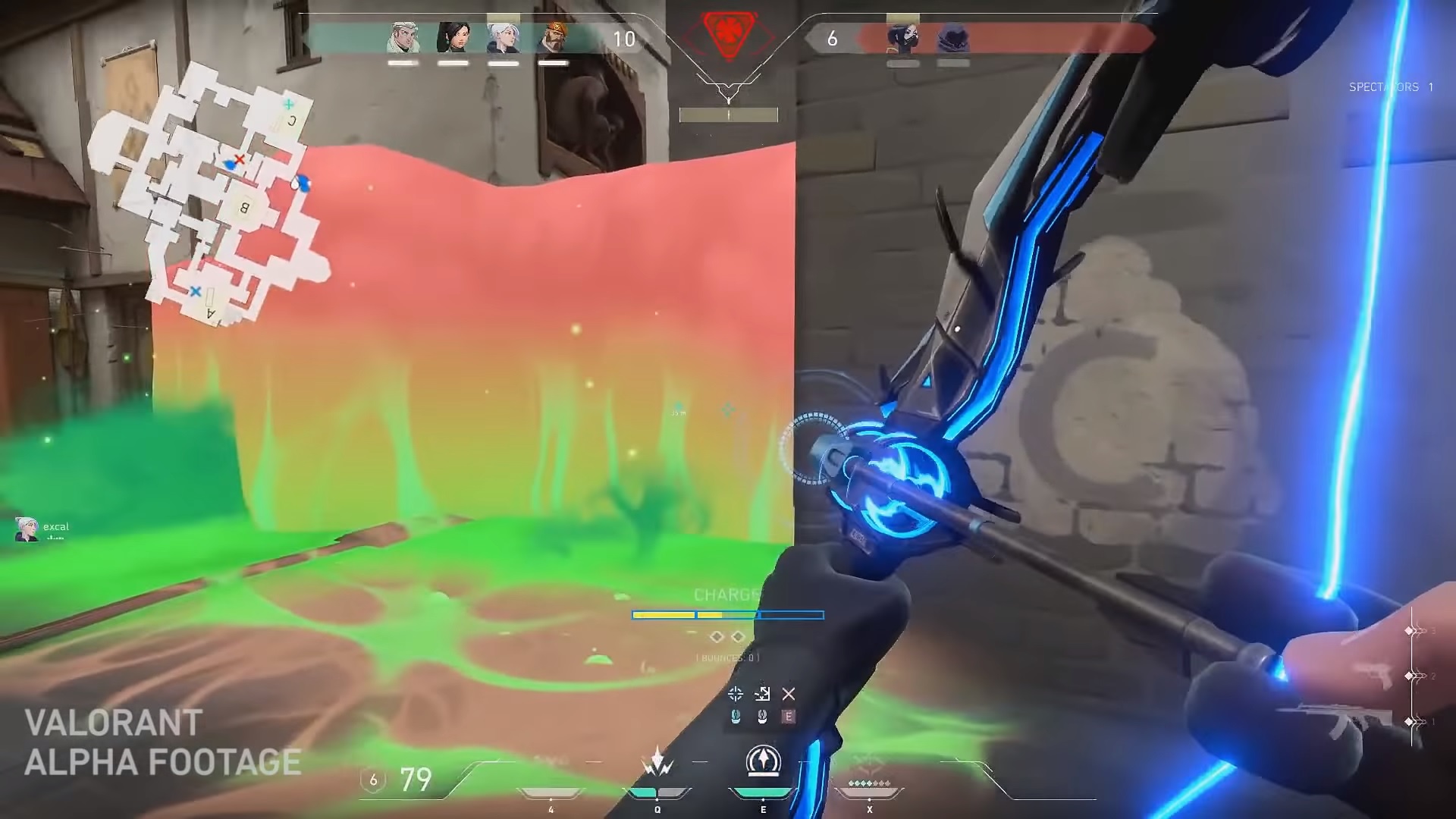
Once it's set up, learn to read it. Blue dots are your teammates. Red marks show enemies that someone has seen or hit. The "you" arrow is you, with a faint cone showing where you're looking. If a teammate dies, their dot disappears and you'll usually see a death icon pop up where they fell.
The big mental shift is this. Empty space on the map doesn't mean it's safe, it means nobody's looked there recently. If your whole team is on the left side of the map and the right side is dark, enemies could be anywhere over there. Don't rotate through unchecked areas like they're clear.
Use callouts to talk to your team
A callout is just the name of a spot on the map, and every map has them. On Ascent you've got places like A Main, Mid Market, and B Site. On Haven it's stuff like A Short and C Long. The names matter because "there's a guy behind the box near B" means almost nothing to a teammate. "One B Main, pushing site" tells them exactly what's happening.
The trick is to keep callouts short and specific. Number of enemies, where, doing what. "Two pushing A Main, one low" is a good call. Yelling "behind you!" to nobody in particular is useless. If you're not sure of the exact name, use something everyone knows, like the site letters, Mid, or spawn. You'll pick up the fancy names over time.
And the flip side matters just as much. Listen. If a teammate calls two on B, don't be the one who keeps pushing A into an empty site assuming it's safe. React to what people tell you.
Glance, don't stare
The habit to build is quick glances. Every couple seconds, flick your eyes to the minimap, same as checking a mirror while you drive. You're not studying it. You're just updating your picture of where everyone is. Do that enough and you'll start noticing gaps before they kill you, which is the whole point.
Unranked to Ranked: When to Queue Competitive
You can't just boot up Valorant and queue ranked on day one. There's a gate, and there's a smarter and a dumber way to walk through it.
Hit account level 20 first
As of Episode 4 Act 1, you need to reach Account Level 20 before Competitive unlocks. That's roughly a few weeks of normal play for most people, depending on how much you play. The level is tied to how much you play, not how well you do, so it comes with time.
Don't rush it. That requirement exists for a reason. Ranked is rough if you walk in not knowing the maps, the agents, or how the economy works. Use those twenty levels to actually learn stuff. Try out a few agents, figure out which role you like, and memorize one or two maps instead of being foggy on all of them. By the time you hit 20, you should be able to buy correctly, name the callouts on at least one map, and not panic when someone flashes you.
Know the rank structure
Valorant has nine ranks, from lowest to highest. Iron, Bronze, Silver, Gold, Platinum, Diamond, Ascendant, Immortal, and Radiant. Iron through Immortal are each split into three tiers, so you've got Iron 1, Iron 2, Iron 3, then Bronze 1, and so on up the ladder. Radiant is the top of the pile, a single tier for the best players in each region.
When you first unlock Competitive, you play five placement matches, and those decide where you start. Most new players land somewhere in Iron to Silver. Don't sweat the exact number. Your visible rank moves around a lot in those early games because the system is still figuring out where you belong.
Don't queue the moment you unlock it
Here's the real advice. The worst time to queue competitive is right after a bad session, when you're tilted, or when you don't know the map yet. Tilt is a rank killer. You play mad, you overpeek, you blame teammates, you lose more, you get madder. It's a loop, and it'll drop you fast.
Pick your moments. Play when you're rested and warmed up, ideally after a few Deathmatch or Range minutes to get your hand working. If you lose two in a row and start feeling heated, step away. Go eat something, play something else, come back later. The rank will still be there.
Warm up and review
A short warmup before ranked is worth it. Five to ten minutes in the Range or Deathmatch gets your aim online so your first ranked game isn't your practice round. Then after you play, especially after a loss, think about why it went sideways. Did you peek too much. Did you forget to use your abilities. Did your team have no smokes. A little honest review beats grinding ten games on autopilot.
The players who climb aren't always the ones with the best aim. They're the ones who play when they're sharp, queue smarter, and fix one thing at a time instead of raging about rank.
Common Beginner Habits That Sink Your Rank
Most low-rank losses trace back to a few repeatable mistakes. Here are the ones that quietly tank your win rate, and how to cut them out.
Running and gunning
If you shoot while moving, your bullets go everywhere. Valorant rewards standing still when you fire. The classic beginner move is to hold W, see an enemy, and spray while running, then wonder why nothing hits. Stop moving, then shoot. Tap or burst, don't hold the trigger down. Strafe to dodge, stop, fire, strafe again. That little stutter-step is called counter-strafing, and it's how good players stay mobile but still accurate.
Crosshair at the floor
Covered this already, but it shows up here because it's that common. New players aim at chest or belly height, or worse, at the ground. Keep it at head level. If you have to pull your aim up to hit a head, you're already too slow. Fix the crosshair and you'll win fights you used to lose.
Wasting or forgetting your abilities
You have abilities for a reason. A lot of beginners save their utility all round and never use it, or panic-throw everything at once. Neither helps. Use your smokes, flashes, and recon before a fight, not after you're already dead. A decent rule of thumb is that if the round ends and you still have your big abilities unused, you probably left value on the table.
Buying whatever, whenever
The economy trips up new players constantly. Both teams start the pistol round with 800 credits. A full buy, meaning a rifle, full shields, and your abilities, runs somewhere around 3,300 to 4,700 credits depending on your agent and weapon choice. If everyone on your team is broke and you buy a rifle anyway, you die, and now you're broke again while your team saves without you. Match your team's buy. If they're saving, save too. If they're full buying, full buy alongside them. Buying together is how you actually take fights you can win.
A simple plan for the first few rounds goes like this. Win pistol, then buy up on round two. Lose pistol, save round two, full buy round three. From there it's mostly about reading the scoreboard and syncing up with your team.
Not trading kills
When your teammate dies, the person who killed them is often still standing right there, low on health or reloading. That's a free kill if you swing immediately. Beginners freeze after a teammate drops, or run the other way. Instead, trade. Push the angle your teammate just died on and clean up. You won't always get the kill, but trading deaths one for one keeps the round from snowballing against you.
Overpeeking and staying still
Two opposite mistakes live here. Overpeeking is when you swing wide into three enemies, maybe take one out, and die, when you could've held and let them come to you. Know when to back off and reposition. On the flip side, staying in the exact same spot after someone sees you is a death sentence. Once you've been spotted or gotten a kill, move. The enemy knows where you are now. Peek again from a different angle and you'll catch them looking at the wrong place.
Tilting and typing
Nothing loses games faster than arguing in chat. The teammate you're yelling at is now playing worse and mad at you on top of it. Mute people who get toxic. The mute button is right there in the scoreboard, so use it early and often. Your mental state matters more than any single round, and a calm team playing together beats five frustrated individuals every time.
The ranked climb in Valorant comes down to fewer big mistakes, not more raw talent. Sort your sensitivity, keep the crosshair at head height, learn one role well, and queue when you're actually ready and warmed up instead of tilted. Pick one habit from the list above and watch it for a week, then move to the next. A quick Deathmatch warmup before you queue competitive costs you about five minutes, and it usually saves you a couple of losses every session.