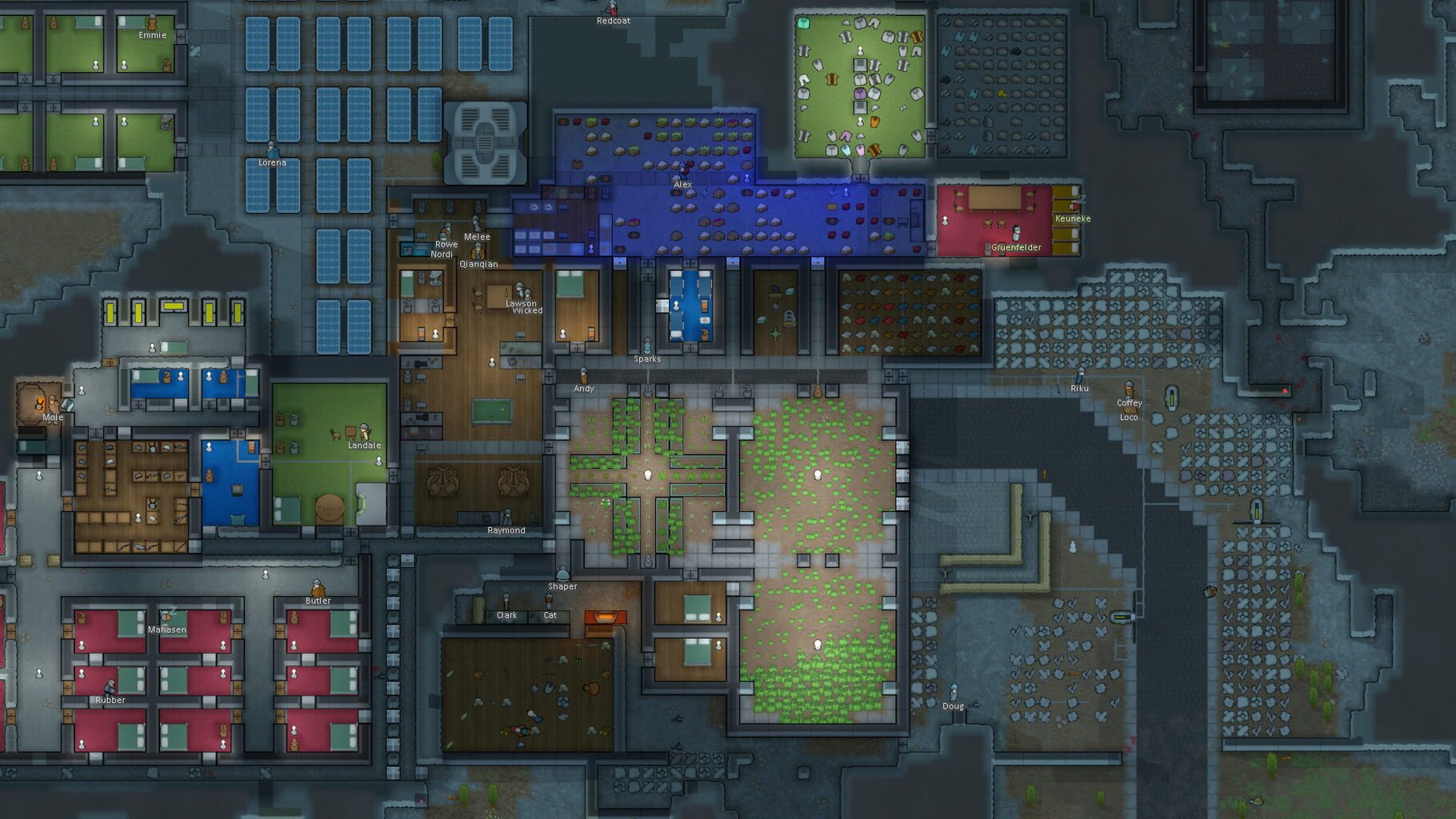
RimWorld Mood Management Guide: Preventing Mental Breaks
How RimWorld mood works, plus the food, bedrooms, schedules, and emergency tricks that stop colonists from having mental breaks.
Mental breaks are RimWorld's way of telling you the colony is being run like a sweatshop. Work people around the clock, feed them paste off the floor, and eventually somebody flips. They eat the whole stockpile, torch the barn, or wander into a blizzard to cry about it. All of it hangs off one number, mood, and the game gives you every tool you need to read that number before it goes bad. Breaks feel random the first few times they happen. They're mostly not.
Reading Mood and Thought Tabs
The bar and the triangle
Click a colonist and open the Needs tab. The blue bar is mood right now, from 0 to 100. The little white triangle underneath is the mood target: every thought on the pawn added together, plus a base mood that comes from difficulty. The bar chases the triangle at up to +12 an hour when things improve, and −8 an hour when they get worse.
That lag matters more than you'd think. Fix a problem and the target jumps on the spot, but the bar needs hours to catch up. A pawn can still crack over a fight you already resolved ten minutes ago.
Base mood by difficulty: 42 on Peaceful and Community builder, 37 on Adventure story, 32 on Strive to survive, 27 on Blood and dust, 22 on Losing is fun. Dropping the difficulty mid-run is a real rescue move when half the map is on fire. It's your game, nobody's grading you.
Thresholds and timers
Three dark lines cut across the mood bar. Those are the break thresholds, and for a pawn with no relevant traits they sit at 35 for a minor break, 20 for a major, and 5 for an extreme. Traits move those lines a lot:
| Traits | Minor | Major | Extreme | | --- | --- | --- | --- | | Iron-willed | 17% | 10% | 2% | | Steadfast | 26% | 15% | 4% | | None | 35% | 20% | 5% | | Nervous | 43% | 25% | 6% | | Too smart | 47% | 27% | 7% | | Volatile | 50% | 29% | 7% |
Neurotic adds +8 to the threshold and Very neurotic adds +14, and those stack with the nerves traits on top. A Volatile pawn hitting major-break danger at 29 mood is a completely different animal than an Iron-willed one who stays safe down to 17. The threshold caps out between 1 and 50 no matter what.
Being under a line isn't an instant break, it's a timer. Below the minor line, the game rolls for a break about once every 4 days on average. Below major, roughly every 0.8 days. Below extreme, every half day. So a pawn sitting at 19 mood probably isn't exploding in the next five minutes, but the clock is running way faster than you want.
One quirk worth memorizing: sleeping pauses the whole clock. Pawns can't break while asleep or unconscious, and their mood bar freezes in place. Keep that in your pocket for the emergency section.
Actually reading the list
The Thoughts tab is where the detective work happens. Every happy and sad thought is listed with its size and how long it lasts. Get in the habit of scanning the biggest negatives first, because the fix is usually sitting right there: a corpse they walked past, an outfit someone died in, a spouse who's been dead for two weeks.
Watch for one sneaky thing, expectations. This thought scales with colony wealth and it's pure free mood when you're poor:
| Colony wealth | Expectations | Mood | | --- | --- | --- | | Under 15,000 | Extremely low | +30 | | 15,000 to 31,000 | Very low | +24 | | 31,000 to 81,000 | Low | +18 | | 81,000 to 182,000 | Moderate | +12 | | 182,000 to 308,000 | High | +6 | | Over 308,000 | Sky-high | 0 |
This is why mood "gets worse for no reason" as you get rich. You're bleeding up to 30 points of cushion you used to get for free. New colonies get a second cushion too: initial optimism is +10 for 8 days before it fades to a +5 version, and that one runs out as well. When everyone mysteriously starts breaking around day 10, that's usually the starter bonus expiring, not anything you did.
Food Bedrooms and Recreation
These three are the permanent mood you buy once and collect forever. The gap between a miserable environment and a great one is worth as much as 60 mood points, which is enormous.
Food
What a pawn ate last is a thought, and the spread is big:
| What they ate | Mood | | --- | --- | | Lavish meal | +12 | | Fine meal | +5 | | Simple meal | 0 | | Nutrient paste meal | −4 | | Raw food | −7 | | Kibble | −12 |
Fine meals take 0.5 nutrition of ingredients (meat and plants, both required) and Cooking 6, and each one feeds back 0.9 nutrition. Lavish meals need Cooking 8 and exactly double the ingredients, 1.0 in for 1.0 out, which is why they're a crisis tool instead of the daily menu. You're paying twice the food for +7 more mood. Nutrient paste is the opposite trade: 0.3 nutrition in for 0.9 out, the most efficient food in the game, at the cost of −4 mood per meal. In a famine, that trade's fine.
Hunger penalties stack up fast when meals slip: −6 hungry, −12 ravenously hungry, −20 malnourished, and it gets worse from there. A meal eaten without a table is another −3, every single meal, so put a table and chairs near the freezer in your first week. That's the cheapest mood in the game.
Keep the kitchen clean, too. Room cleanliness feeds directly into food poisoning odds on prepared meals, and food poisoning means sick pawns (−5) vomiting instead of working. A clean floor and a cook with skill 4 or better handles most of it. And if you've got an Ascetic pawn, good news, they don't mind the paste at all.
Bedrooms
Every room has four stats: wealth, beauty, space, and cleanliness. Those roll up into one score called impressiveness, and the weakest stat counts for about half of it. A masterpiece sculpture in a vomit-covered room does almost nothing. Space and cleanliness are usually the bottleneck, and since the mood jumps happen at hard tier lines, a single speck of dirt can drop a room a whole tier. Clean floors are mood.
| Bedroom impressiveness | Mood | | --- | --- | | Awful (under 20) | −2 | | Mediocre (30 to 40) | +1 | | Decent (40 to 50) | +2 | | Slightly impressive (50 to 65) | +3 | | Impressive (65 to 85) | +4 | | Very impressive (85 to 120) | +5 | | Extremely impressive (120 to 170) | +6 | | Wondrously impressive (240+) | +8 |
The boring build works: a 4x6 or 5x5 room, carpet, a decent bed, dresser, end table, lamp, and a plant or small sculpture. That lands around impressive (+4) for one pawn's worth of furniture. Returns diminish hard past very impressive, so don't gold-plate one bedroom while the dining room still has dirt floors.
Barracks are the budget option and they charge rent. An awful barracks is −7, and even a decent one is still −3, roughly 5 mood worse than an equivalent private bedroom at the low end and 4 at the high end. Shared rooms early are fine. Move people out as soon as you can.
Two thoughts people forget: beauty and space apply everywhere, not just where you sleep. A gorgeous environment is +15 and a hideous one is −15, cramped is −5 and spacious is +5, so sculptures and open floor in the workshop pay for themselves. Comfortable seating counts too, and sitting in a good armchair builds the comfort need all the way up to +10.
Trait gotchas: Greedy pawns sulk without an impressive bedroom, Jealous pawns sulk if anyone's room is nicer, and Ascetic pawns are backwards from everyone else and want it dull.
Recreation
The fun need runs its own mood thoughts: +10 fully satisfied (85 and up), +5 satisfied (70 to 85), nothing in the middle, then −5 unfulfilled, −10 deprived, and −20 if it hits zero. It drains about 2.5% per hour awake, so a pure work day ends deep in penalty territory.
Variety is the other half. Pawns build tolerance to each kind of fun (about two thirds of the recreation they gain), and past 50% tolerance they're bored of that activity and stop seeking it out. There are ten types: solitary relaxation, social interaction, cerebral play, dexterity play, reading, television, telescope study, music, chemical consumption, and food consumption. Richer colonies need more of them, because tolerance fades slower as wealth grows:
| Colony wealth | Recommended types | | --- | --- | | Under 15,000 | 2 | | 15,000 to 31,000 | 3 | | 31,000 to 81,000 | 3 | | 81,000 to 182,000 | 4 | | 182,000 to 308,000 | 5 | | Over 308,000 | 6 |
A chess table, a horseshoes pin, a tube TV, and a bookshelf between them will carry a young colony a long way. Add billiards or a poker table as the wealth climbs. Put a TV in the hospital as well, since pawns stuck in bed can only watch TV for fun. It's the one recreation that works for patients.
Chocolate is a decent stopgap, 10% nutrition and 10% recreation per unit, if a trader's got some to spare.
Scheduling Work and Rest
The Schedule screen sets what each pawn does with each hour of the day, and the settings behave very differently behind the scenes:
| Setting | Recreates when | Eats when | Sleeps when | | --- | --- | --- | --- | | Anything | Rec below 35% | Food below 30% | Rest below 30% | | Work | Never | Food below 30% | Only by collapsing | | Recreation | Rec below 95% | Food below 30% | Rest below 30% | | Sleep | If no jobs left | Food below 30% | Rest below 75% |
Work is the scary one. Pawns on Work never have fun, period, so recreation just bleeds out until −20 is running permanently. Rest hits zero and they collapse wherever they stand, then wake at 20% rest and go again. The wiki says flat out that permanent work schedules have a high chance of mental breaks. Use it for a harvest day, not a lifestyle.
A setup that works for most colonies: a sleep block overnight, one or two Recreation hours right after waking, another block before bed, and Anything for the rest. The morning fun block tops the need off into the +5 range instead of letting it drift down all day. In bigger colonies, stagger the rec hours so eight people aren't fighting over one billiards table.
Night owls get their own plan: schedule their sleep from 10:00 to 18:00. They stay up all night penalty-free (with the night owl buff active) and snooze through the day debuff window.
Rest penalties are their own spiral: drowsy −6, tired −12, exhausted −18. Disturbed sleep is another −1 per interruption, up to 3 stacks, from people tramping through the room, which is one more quiet argument for private bedrooms. Pawns on Sleep wake at 100% rest, or if food drops under 12.5% while breakfast is in reach. If you've got Royalty, Meditate hours are sneaky good, meditation counts as solitary relaxation and fills recreation to 100% while it refills psyfocus.
And the scheduling trick that doubles as first aid: a pawn sent to bed is a pawn whose break clock is stopped.
Handling Grief and Pain
When someone dies
Death is the classic colony killer, because the thoughts are huge, they stack, and they last a month. The personal relationship ones do the real damage:
| Who died | Mood | Lasts | | --- | --- | --- | | Husband, wife, son, daughter | −20 | 30 days | | Fiancé or fiancée | −18 | 30 days | | Lover | −16 | 30 days | | Brother or sister | −14 | 30 days | | Friend | −10 | 20 days | | Bonded animal | −8 | 20 days |
Everyone else also carries −3 "colonist died" for 6 days, or −6 "colonist lost" if the pawn vanished instead. Repeat deaths stack the same thought with diminishing returns (each extra stack is worth 75% of the last, up to 10 deep). A raid that kills two spouses can easily pin −40 to −60 across half the colony for a month, and that's exactly how death spirals start: everyone sits at 20 mood, somebody goes berserk, and now there's a fresh body and fresh grief.
So what do you actually do?
- Bury fast. "Colonist left unburied" is −10 for the whole colony and it doesn't expire, you fix it or it stays. A grave solves it, and a sarcophagus even gives +4 colony-wide for 8 days.
- Keep corpses out of sight. Seeing a corpse is −4 (stacks 3 times) and a rotting one is −6 (stacks 5 times). Haul raid bodies to a grave or stockpile instead of leaving them by the front door.
- Pre-buffer through the bad month: lavish meals, extra rec blocks, a nicer dining room. You're outlasting timers, not deleting them.
- Psychopath pawns skip nearly all of this, which makes them weirdly good crisis staff.
One rare mercy: a Resurrector mech serum doesn't just bring the body back, it deletes the death mood penalties too.
Pain, sickness, and the psychic hum
Pain runs four tiers: minor −5, serious −10, intense −15, mind-shattering −20. Wimps feel it all worse (their pain thoughts never dull), masochists enjoy it, and everyone else just suffers. The counter is boring good medicine: treat wounds quickly, keep a clean hospital and a real doctor, and get hurt pawns into beds instead of limping through a 14-hour shift at intense pain. Being sick is its own −5 on top.
Psychic drone events stack on when you least want them: low −12, moderate −22, high −30, extreme −40, all scaled by the pawn's psychic sensitivity. (The rare psychic soothe is +16, enjoy it.) Some drones come from a crashed ship you can go destroy. Otherwise you ride it out, and if one lands on a colony that's already grieving, that's the moment to skip ahead to the emergency toolbox.
Social hits belong here too. Insulted is −5 a pop and stacks 10 deep, and insults escalate into social fights that put somebody in the hospital generating everything above. On the happy side: kind words are +5, "got some lovin'" is +8, and a partnered pawn gets mood equal to 10% of their opinion of their other half, so a +80-opinion spouse is a quiet permanent +8. Singles who want love carry "sleeping alone" at −4. Don't make rivals share a bedroom, that's just scheduling a fistfight.
Emergency Responses to Low Mood
So what's an actual emergency? Any pawn under a threshold line with the bar still falling, or any break already in progress. Work the list in order.
Kill the cause, then patch the number
Open the Thoughts tab and remove the biggest negative you can actually remove. A rotting corpse in the hallway is −6 gone in one hauling job. Tainted apparel is −5, swap the outfit. Nobody breaks in a vacuum, something is always driving it.
Then buy time with fast mood. Lavish meal is +12 with no downside beyond ingredients. A recreation block pushes toward the +10 fully satisfied thought. After that come drugs: psychite tea +12, smokeleaf +13, beer +10 up to +26 as they get drunk. Flake and yayo are +35 and that's a trap, with withdrawal sitting at −35 (psychite and alcohol), −22 (go-juice and wake-up), or −20 (smokeleaf), plus hangovers at −3 to −12. Ambrosia at +5 is the gentlest of the bunch if it's around.
The sleep trick deserves its own line: breaks can't fire while a pawn is asleep, the mood bar freezes, and a food binge literally ends when they lie down. For long events like drones, a cryptosleep casket parks a pawn safely until it's over. Anesthetic from your doctor works too, kind of a pain, but it works.
If the break happens anyway
Read the icon over their portrait. Yellow lightning means non-aggressive (sad wander, hide in room, food binge), red means aggressive (tantrum, berserk, slaughterer). Most yellow breaks you can just let run in a safe, fenced colony, and when it ends they get catharsis, +40 mood for 3 days. The one to interrupt is targeted insulting spree: ten stacked insults on one victim is up to −33, and now you have two pawns in trouble instead of one.
Arresting ends a break early. The arrester's stats decide whether the pawn comes quietly (break over, escorted to a prison bed) or explodes into berserk. Release them afterward and they rejoin, but they get −6 "was imprisoned" for 12 days instead of catharsis, so arrest is a fire extinguisher, not a routine. Actual berserk pawns can't be arrested at all. Your only option is downing them with blunt weapons (a pain knockout), which risks killing an already injured pawn, and it doesn't work on go-juice users or anyone with a Painstopper. Royalty players get the clean answer: Word of Serenity ends any break instantly by forcing a 6-hour coma.
The nuclear option is the Joywire brain implant: +30 mood, forever, at the cost of −20% consciousness, and it never comes back out. That's for pawns whose negatives you truly can't remove, burn scars, luciferium, a family of six in the graveyard. The infamous peg-leg trick (no legs, no tantrums) also exists, and the game really does let you do it, but that's between you and your conscience.
Two freebies to close on. Destructive breaks often leave the pawn marked guilty, and guilty pawns can be banished or executed without the usual colony-wide mood hit. And catharsis stacks up to 5 times with diminishing returns, so after any break you've got a +40 window of about three days. Spend it fixing whatever caused the break, because if you don't, you'll be right back here next week. The cheapest prevention in the whole game is still a table with chairs: −3 mood per meal, every meal, gone for a handful of wood. Build it on day one.